

INTRODUCTION
If you own a home in San Tan Valley, or you’ve been watching it as a place to buy, you’ve probably heard the news. San Tan Valley voted to incorporate, and it’s officially transitioning to city status in 2026.
That’s a big deal. And depending on who you ask, it’s either exciting or a little nerve-wracking, sometimes both.
I’ve had a lot of conversations with clients and homeowners in the area who have real questions, not just “is this good or bad” but “what does this actually change for me?” So I want to give you a straightforward answer to what I know, what we’re watching, and what it means if you’re thinking about buying or selling there this year.
FIRST, A LITTLE CONTEXT ON HOW THIS HAPPENED
San Tan Valley has been one of the fastest-growing unincorporated communities in Arizona for years. It sits in Pinal County, and until now, it’s operated under county governance rather than as its own city.
That setup worked when the area was mostly open land and smaller subdivisions. But San Tan Valley now has over 100,000 residents, multiple master-planned communities, major retail, and a growing job base. At that scale, county-level services start to feel like they weren’t built for what the community has become.
The incorporation vote passed, and the community is now moving through the formal process of standing up city government, which includes establishing city services, adopting a city budget, and eventually levying a city tax structure.
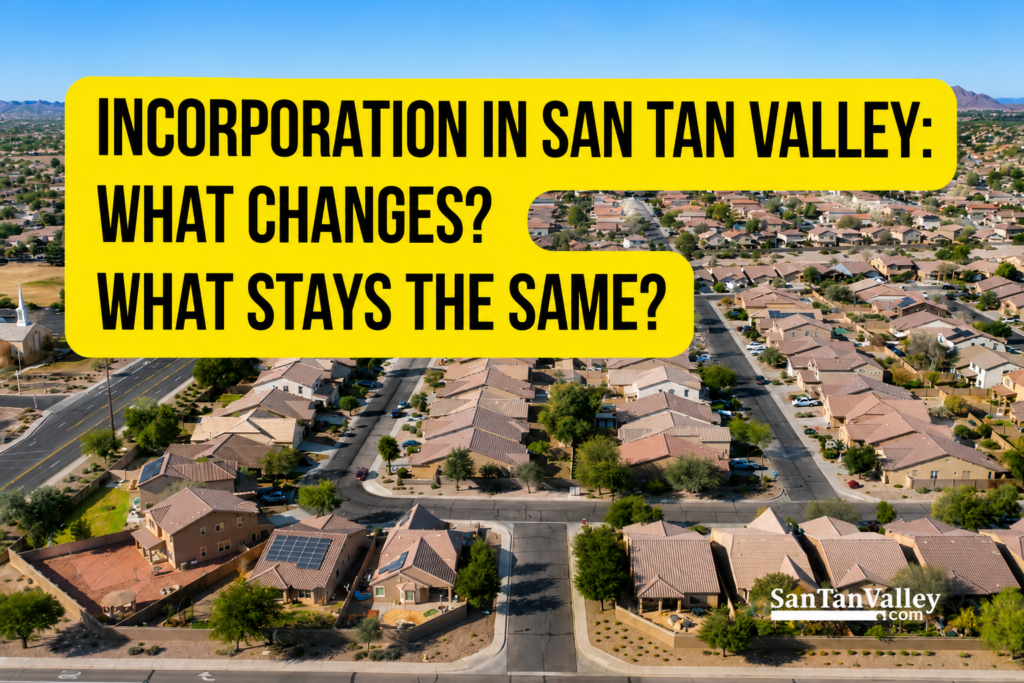
WHAT CHANGES WHEN A COMMUNITY INCORPORATES?
This is the question I hear most often, so let me walk through the main areas.
Services and Infrastructure
One of the biggest potential benefits of incorporation is local control over services. City status gives San Tan Valley the ability to prioritize road maintenance, parks, public safety resources, and infrastructure improvements based on what its residents actually need, rather than competing for Pinal County resources against communities that may have different priorities.
For homeowners, this often translates to more responsive local government and faster movement on things like road repairs and development approvals.
Zoning and Land Use
This one matters a lot to both existing residents and buyers. As an incorporated city, San Tan Valley will have its own zoning authority. In the short term, that means more local control over what gets built and where. In the long term, it tends to result in more intentional land use planning, which can protect property values in established neighborhoods.
Property Taxes
I know this is the one everyone is thinking about, so let me be direct. Incorporation does not automatically mean your property taxes go up overnight.
What happens over time is that a city may levy a city-specific primary property tax, which Pinal County currently does not. Whether San Tan Valley does this and what rate they set is a decision that will be made through the new city government. It’s something to watch, and I’d encourage homeowners to stay engaged in local elections and city council meetings as that process unfolds.
What I can tell you is that many newly incorporated Arizona cities have structured their tax approach carefully, especially in communities where affordability has been a core selling point. San Tan Valley’s leaders know that pricing out their existing residents is not a winning strategy.
WHAT THIS MEANS FOR HOME VALUES
Here’s my honest take.
In most cases across Arizona, incorporation has been a net positive for home values over time. The reason is pretty simple: city status brings more resources, more infrastructure investment, and often more economic development. Businesses that prefer to locate within an incorporated city, rather than an unincorporated area, now have a reason to consider San Tan Valley.
That said, the near-term impact is mostly psychological right now. We don’t yet know what the city’s tax structure will look like, and that uncertainty can make some buyers pause. That’s actually what creates an opportunity for buyers who are comfortable doing their homework.
San Tan Valley is currently sitting in buyer-favorable market conditions. Inventory is up, days on market have extended, and sellers are more flexible than they were a year ago. Pairing that market dynamic with the long-term upside of incorporation is a combination worth paying attention to.
SHOULD YOU BUY IN SAN TAN VALLEY RIGHT NOW?
If you’ve been considering San Tan Valley, here’s how I’d think about it.
The buyers who tend to do well in a transitional market like this are the ones who are buying for the right reasons: they like the lifestyle, the price point works for them, and they plan to stay long enough for the community to grow into its new status. San Tan Valley has always offered more space for the money than Gilbert or Chandler, and that math doesn’t change with incorporation.
If you’re stretched thin and need to predict every line item of your monthly costs for the next five years, now is a time to watch carefully and stay engaged with what the new city government announces on taxes and services.
If you have some flexibility and you’re drawn to the community, the current market conditions mean you have negotiating leverage that didn’t exist a year or two ago.
WHAT IF YOU ALREADY OWN A HOME THERE?
Keep an eye on a few things.
First, get involved if you can. New city governments are shaped by the people who show up. Attend a council meeting, follow local news coverage of the incorporation process, and pay attention to what’s being proposed on taxes and zoning.
Second, know that city status typically brings more investment to an area over time, not less. Services improve, infrastructure gets funded more directly, and the community’s identity sharpens. Long-term, that tends to support property values.
Third, if you’re thinking about selling in the next one to three years, the window of uncertainty that follows incorporation is often when buyers are most cautious. That doesn’t mean you can’t sell, but it may influence your timing strategy. I’m happy to talk through that with you specifically.
THE BOTTOM LINE
San Tan Valley’s incorporation is one of the most significant local real estate stories in the East Valley right now, and it’s something most agents haven’t dug into yet. I’ve been watching this closely because I have clients who live there and clients who are asking me whether to buy there.
My read: this is a community in transition, and transitions like this, when they’re handled well, tend to lift the areas that go through them. San Tan Valley has the population, the growth trajectory, and the community investment to make this work.
If you have questions about what this means for a specific street, subdivision, or purchase decision, reach out. That’s exactly the kind of conversation I’m built for.
Cheri Smith
REALTOR® | eXp Realty
480-298-5551
cherismithrealtor.com
@cherismith.azrealtor