

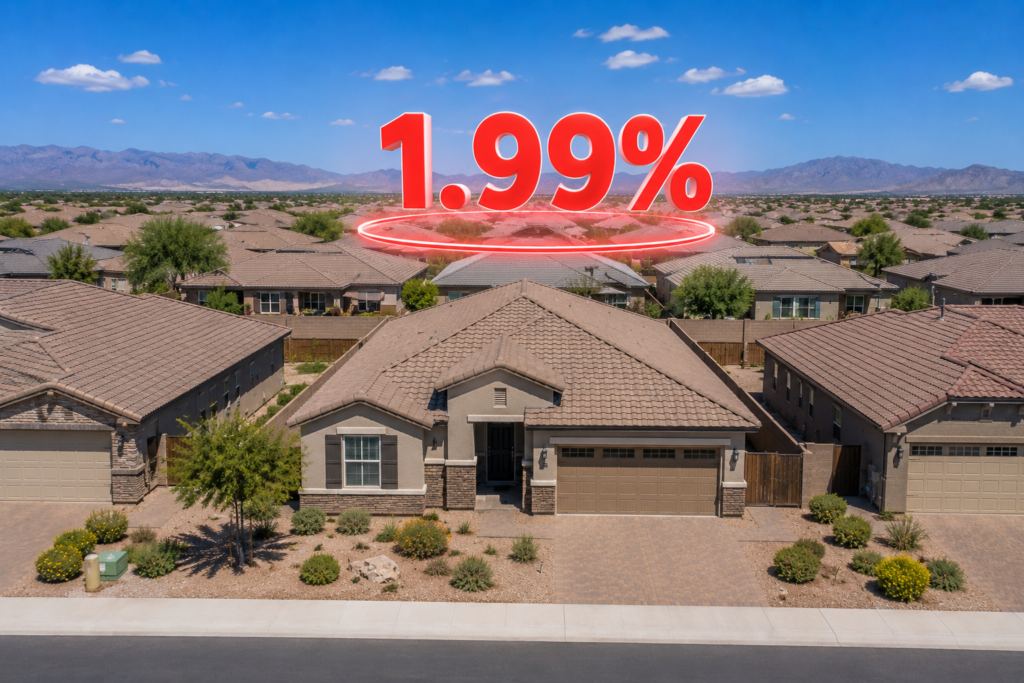
If you’ve been touring new construction in Queen Creek lately, you’ve probably seen it on a sign or heard it from a sales rep: rates as low as 1.99%.
And your first reaction was probably something like: wait, is that real?
The short answer is yes – and also, it’s more complicated than it sounds.
I’ve been helping buyers navigate new construction in the East Valley for years, and right now, builder-offered rate buydowns are one of the most misunderstood tools in the market. They can be genuinely useful. They can also be a distraction from a bigger negotiation. Knowing the difference is the whole game.
Here’s what’s actually going on.
What a Rate Buydown Is
A rate buydown is when someone – in this case, the builder – pays upfront to reduce the mortgage rate for the buyer, either temporarily or permanently.
The promotional rates you’re seeing right now in Queen Creek – some as low as 1.99% in the first year – are typically what’s called a **temporary buydown**. The most common structure is a 2/1 buydown: the rate is reduced by 2% in year one, 1% in year two, then settles at the full rate (currently around 6.3–6.43% conventional) in year three and beyond.
So when a builder advertises 1.99%, that number applies to your first 12 months of payments. Not your entire loan.
The difference in monthly payment during year one is real and meaningful. On a $600,000 loan, the difference between 1.99% and 6.3% is roughly $1,200–$1,400 per month. That’s money in your pocket for the first year, which gives you runway to settle in, complete furnishing, or build your savings back up after closing.
But after year one, your payment adjusts to year two’s rate, and then to the full rate in year three. Your budget needs to account for all three.
Why Builders Are Offering This Right Now
This is worth understanding because it tells you something about your negotiating position.
Queen Creek inventory is up significantly. There are roughly 1,000 active listings right now, and homes are sitting an average of 93 days before selling. Builders with communities actively delivering homes are under real pressure to move product. Buydowns are one of the most effective tools they have to reduce the monthly payment – which is what most buyers make their first affordability calculation on – without officially reducing the sales price (which would set a price precedent for the rest of the community).
That matters to you as a buyer, because it means the buydown is not pure generosity. It’s a business decision designed to make the payment feel more accessible while protecting the list price. That doesn’t make it bad – it just means you should understand what’s being offered and what isn’t.
The Trade-Off Most Buyers Don't See
Here’s what often gets missed: builders who offer rate incentives typically require you to use their preferred lender to access the promotion.
That’s not automatically a problem. Builder-affiliated lenders are often competitive and sometimes genuinely excellent at closing on new construction timelines, which can be complicated. But using the builder’s lender means you’re not independently shopping your rate and closing costs – and closing costs on new construction can vary significantly from lender to lender.
Before you commit to the builder’s financing, do these two things:
1. Get a competing quote from your own lender first.** Find out what your rate and total loan costs look like without the buydown from an independent lender. Then compare that true apples-to-apples against the builder’s package – full rate (not just year one), all loan fees, and any points built into the structure.
2. Ask the builder directly:** “If I bring my own financing, what happens to the buydown incentive?” In some communities, the builder will convert the buydown value to a price reduction or closing cost contribution for cash or outside-lender buyers. In others, you forfeit it. Knowing this changes your negotiating position entirely.
When the Buydown Actually Makes Sense
After you’ve done the comparison above, a temporary buydown can be a genuinely good tool in specific situations:
You expect your income to increase. If you’re in a career where your earnings in years two and three will be meaningfully higher than today – you’re early in a tech role, finishing a degree, expecting a promotion – the lower payment in year one buys you time to grow into the full payment without financial strain.
You’re coming in from out of state. Relocation buyers often have high upfront expenses: moving costs, travel, furnishing a new home, establishing routines. A first-year payment reduction can make the transition more manageable.
You plan to refinance if rates drop. The conventional wisdom right now is that rates may ease in 2025–2026. If you believe that and plan to refinance when it makes sense, the buydown gives you lower payments while you wait for a better rate environment – and you only need the full rate to be comfortable if refinancing doesn’t happen on your expected timeline.
You’ve verified the underlying purchase price is competitive. This is the most important one. If the builder is selling you the home at a price that already includes the cost of the buydown – meaning you’re effectively paying for it through the purchase price – the math looks different than if the home is priced competitively and the buydown is a genuine incentive on top.
A good buyer’s agent will pull comps in the community, look at what finished homes have closed for, and help you understand whether the list price is fair before you factor in any rate incentive.
A Word on Permanent Buydowns
Some builders also offer points to permanently reduce your rate – not just for year one, but for the life of the loan. These tend to make sense if you’re planning to stay in the home for at least 5–7 years and can calculate the exact break-even point on the upfront cost.
If a builder is offering you a choice between a temporary and a permanent buydown, or between a buydown and a price reduction, the right answer depends on your specific loan amount, your timeline, and your financial situation. It’s worth sitting down and running the actual numbers before you commit.
This is the kind of thing I walk through with buyers in new construction consultations before we ever step foot in a model home. The more you understand going in, the better position you’re in to negotiate.
The Queen Creek Context
Right now in Queen Creek, builders have real incentive to work with you. Prices are down around 5.7% year over year, inventory is the highest it’s been in years, and homes are taking 90+ days to sell. That’s a market where a motivated buyer – one who shows up pre-approved, clear on what they want, and ready to move – has leverage.
A rate buydown is one tool. A price negotiation is another. Closing cost contributions are another. In a market like this one, you often don’t have to choose just one.
The goal is to walk into that builder’s office knowing your full picture: what you qualify for, what the home is actually worth, and what combination of incentives adds up to the best deal for your specific situation. That’s a different conversation than just responding to whatever’s on the sign out front.
If you’re looking at new construction in Queen Creek and want to talk through how to approach the builder conversation – or you want to see what’s currently available in communities with active incentives – I’m glad to help.
Cheri Smith
REALTOR® | eXp Realty
480-298-5551
cherismithrealtor.com
@cherismith.azrealtor