

QUICK ANSWER
Chandler’s citywide average price is misleading right now. Homes near the Price Road tech corridor are holding steady thanks to strong Intel and semiconductor employment, while other Chandler neighborhoods are softening as inventory rises. The real answer depends on your specific street, not the metro headline, so a neighborhood level comparison matters more than the citywide number this year.
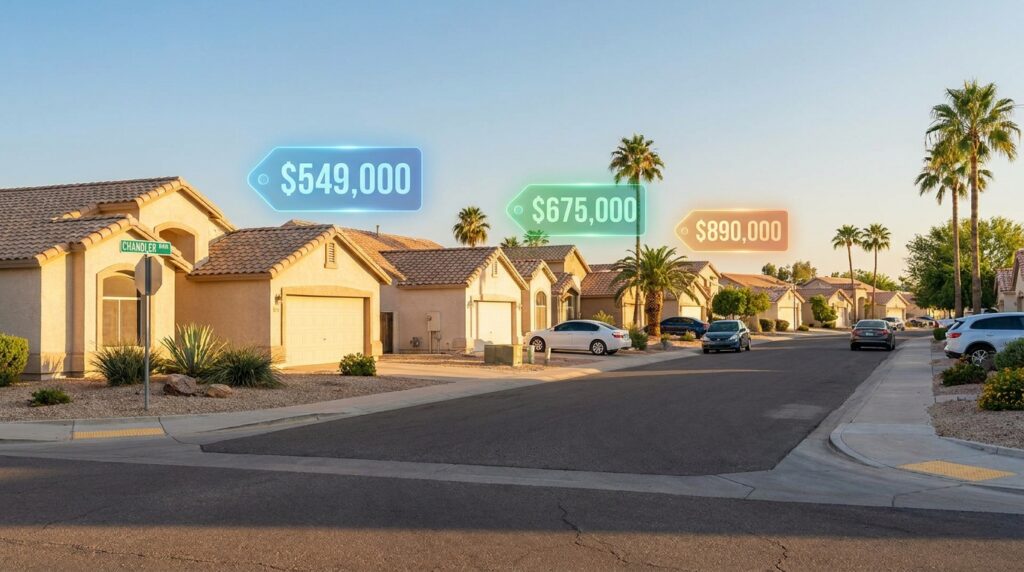
If you’ve searched “Chandler home prices” this month, you’ve probably noticed something frustrating. One source says prices are up. Another says they’re down. A neighbor swears the market is booming, and your cousin who just listed her house says buyers barely showed up. None of you are wrong. You’re just looking at different pieces of the same city.
I get this question constantly from clients right now, both people trying to buy in Chandler and people trying to sell there, and they’re all asking some version of the same thing: which number do I actually trust? So let’s set the citywide average aside for a minute and talk about what’s really happening block by block, because that’s the only version of this story that will actually help you make a decision.
I work Chandler alongside Gilbert, Queen Creek, Mesa, and San Tan Valley, and Chandler is the trickiest of the five to summarize in one headline. It’s a big city with very different pockets, and treating it like one market is exactly why the numbers keep contradicting each other.
WHY DO CHANDLER HOME PRICE REPORTS CONTRADICT EACH OTHER RIGHT NOW?
Citywide averages blend everything together. A luxury remodel near the tech corridor and a dated starter home three miles away both go into the same pot, and whichever pocket had more activity that month tips the average one direction or the other. That’s how you end up with one report saying Chandler is up and another saying it’s down, sometimes in the same week. Neither is lying. They’re just measuring a city that isn’t behaving the same way in every part of it.
This year the split is sharper than usual because Chandler has two very different forces pulling on it at once. One part of the city has a steady, well paying employer base anchoring demand. The rest of the city is dealing with the same rising inventory and slower pace that’s showing up across the East Valley. Average it all together and you get a number that doesn’t describe anyone’s actual street.
WHAT'S ACTUALLY HAPPENING TO HOME VALUES NEAR THE PRICE ROAD TECH CORRIDOR?
This is the part of Chandler holding up the best right now. Intel and the semiconductor employers along the Price Road corridor keep bringing in buyers with stable jobs and real urgency to close, whether that’s a relocation, a promotion, or a family that’s decided to put down roots near work. That kind of buyer doesn’t wait around for the “perfect” moment. They need a home on a timeline, and that steady demand is keeping homes near the corridor from softening the way some other parts of the city are.
If you own a home in this stretch of Chandler, the pullback you might be reading about in the news is probably not describing your street. If you’re a buyer hoping for a big discount specifically near the tech corridor, I’d temper that expectation. This is the pocket where competition hasn’t really eased.
WHICH CHANDLER NEIGHBORHOODS ARE SOFTENING RIGHT NOW?
Away from that corridor, the picture looks more like the rest of the East Valley. Inventory across the Phoenix metro is up meaningfully compared to a year ago, and Chandler neighborhoods without a concentrated employer base nearby are feeling that the most. Homes are taking longer to go under contract, and sellers in these areas are having to price to this month’s activity, not last year’s comps or what a house two streets over sold for during a stronger stretch.
This doesn’t mean these neighborhoods are struggling. It means buyers there have more room to negotiate than they’ve had in a while, and sellers need a pricing strategy built on current data for their specific pocket, not a citywide average that’s being pulled in the opposite direction by the tech corridor.
IS CHANDLER, ARIZONA A BUYER'S MARKET OR A SELLER'S MARKET RIGHT NOW?
Both, depending on where you’re standing. Near the Price Road corridor, sellers still have real leverage because demand hasn’t let up. In the neighborhoods further from it, buyers have gained genuine negotiating room as homes sit longer and inventory climbs.
This is exactly why I tell clients not to trust a single citywide label for a city this size. “Chandler” isn’t one market this year. It’s several smaller ones, and the honest answer to “is now a good time to buy or sell in Chandler” is always going to start with “which part of Chandler.”
WHAT DOES THIS MEAN IF YOU'RE BUYING OR SELLING IN CHANDLER THIS FALL?
If you’re selling near the tech corridor, you’re likely still in a reasonably strong position, but that doesn’t mean skip the prep work. Buyers here are qualified and serious, and they’ll still compare your home against others nearby.
If you’re selling further from the corridor, price matters more than it did a year or two ago. This is where a real conversation about your specific street’s recent activity, not a metro number, protects you from either overpricing and sitting, or underpricing and leaving money on the table.
If you’re buying, the corridor is where you’ll still face real competition. The neighborhoods further out are where you’re likely to find more room to negotiate on price, terms, or closing costs. Either way, rising rates this month, with the 30 year fixed briefly touching 7% before settling closer to 6.9%, are adding pressure to monthly payments across the board, which is one more reason a specific, current answer matters more than a general one right now.
MY TAKE
Headlines need one number. Real neighborhoods don’t work that way, and Chandler is proof of it this year. If you’re trying to make a decision based on a citywide average, you’re working with a number that’s actively canceling itself out. What you actually need is a look at your specific street or the specific pocket you’re considering, compared against what’s genuinely happening there right now.
I’d rather walk you through your actual comps than hand you a headline. If you’re weighing a move in Chandler, whether that’s buying near the tech corridor or figuring out the right price for a home further out, reach out and let’s look at your specific situation together. No pressure, just real numbers.
FREQUENTLY ASKED QUESTIONS
Q: Why do different websites report different home prices for Chandler, Arizona?
A: Different sites often pull from different date ranges, home types, or areas within Chandler, and citywide averages blend high demand pockets with softer ones into a single number. That’s why one report can show prices rising while another shows them falling in the same month. The most reliable answer comes from comparing recent sales within your specific neighborhood, not a metro wide average.
Q: Are home prices near the Price Road tech corridor in Chandler still going up?
A: Homes near the Price Road corridor are holding steady rather than softening, largely because of consistent demand from Intel and semiconductor sector employees who need to relocate or buy on a timeline. This pocket has not seen the same pullback showing up in other parts of Chandler.
Q: Is it a good time to buy a home in Chandler, Arizona?
A: It depends on the neighborhood. Near the tech corridor, competition remains real and buyers should expect limited room to negotiate. In neighborhoods further from that corridor, rising inventory has given buyers more negotiating leverage than they’ve had in recent years.
Q: Should I lower my asking price if I’m selling in Chandler right now?
A: Not automatically, and it depends entirely on where your home is located. If you’re near the Price Road corridor, demand is still supporting stronger pricing. If you’re in a neighborhood that’s seeing more inventory and slower activity, pricing based on this month’s local comps, rather than last year’s numbers, will serve you better than holding out for an older price point.
Cheri Smith
REALTOR® | eXp Realty
480-298-5551
cherismithrealtor.com
@cherismith.azrealtor